

UK Firefighter Fitness Tests: What Tests Do You Need to Pass?


Becoming a firefighter in the UK can be extremely competitive. Recruitment is often a lengthy process, with candidates being required to meet a range of eligibility, medical, fitness and practical standards before they can progress towards appointment and firefighter training.
One part of this process is the physical assessment stage. The termin
ology used can vary between different services, with terms such as fitness tests, physical tests, practical selection tests, job related tests and National Firefighter Selection Tests being commonly used across the sector.
The Physicals include multiple assessments that you will need to pass. If you fail one, then your recruitment process is usually over. Typically, you will book onto an assessment day and be required to travel to that location. Throughout the day, you'll complete the assessments required. It's important to listen to all instructions on the day, as I've found that a lot of people have previously failed not due to lack of fitness, but because they failed to listen to instructions resulting in safety critical rules being broken and wrongful execution of tasks. The exact assessments can differ between services, too, with each service selecting local assessments from a wider pool of available assessments.
This guide explains the most common physical and practical assessments currently used across public sector UK Fire & Rescue Services, including the common national tests, and aerobic fitness assessments. It does not include every single test a fire service may use, however at the end of this guide, there will be a table identifying some other assessments known to be used which will be covered in another guide. Before you apply to your fire service, it's key to know the assessments that you will need to pass in order to prepare in time for them.
The most common UK Firefighter Physical and Practical Fitness Tests.
Although there are more assessments than the following ones, the most common assessments across the UKFRS are:
TEST | MAIN QUALITIES ASSESSED |
Ladder Climb | Confidence working @ height, following instructions, co-ordination, mobility. |
Ladder Lift | Upper body vertical push strength and endurance, core stability, co-ordination, control. |
Casualty Evacuation | Full body strength and endurance, lower body power, grip strength, hip mobility, co-ordination, work capacity, core stability. |
Enclosed Space Test | Spatial awareness, agility, mobility, confidence, calm under pressure, problem solving, following instructions. |
Equipment Assembly | Manual dexterity, co-ordination, mechanical understanding, following instructions, calm under pressure. |
Equipment Carry | Aerobic fitness, work capacity, load carriage capability, strength and endurance, grip strength, following instructions. |
The Ladder Climb.

The Ladder Climb is exactly what it says on the tin... you climb a ladder to prove your ability to work safely and confidently at height.
You must climb the ladder following specific instructions like "you must not touch the strings of the ladder at any point". Once you are towards the top of the ladder, the instructor will direct you to perform a leg lock (demonstrated beforehand) and then lean back without touching the ladder (usually arms spread out). NOTE - You will not fall so be confident!
Depending on the service, you may also be required to twist whilst leaning away from the ladder to identify a shape, number, or object that the instructors have placed near them.
Following this, you will return to the ladder making sure to be touching the rounds only, come out of the leg lock and then descend confidently.
The test is usually performed on a 13.5m or similar ladder and you are connected to a pulley system so if you were to fall at any point (you will not), you won't drop. The trick for this test is to be confident and listen to the instructions. There are many people who join the fire service with a fear of heights - it's not a restriction. As long as you can do this test without breaking the instructions, you will be fine. Just be mindful that when you are in the role, there is no safety harness.
The Ladder Lift.

The Ladder Lift is also a simple test like the Ladder Climb. Unlike the Ladder Climb, which is a practical test rather than fitness test, the Ladder Lift is a fitness test assessing whether you have the vertical pushing strength to safely raise and lower a simulated ladder load which approximately results to 25-30kg depending on the service.
Using a bar or ladder simulator, you are required to lift the loaded object to a specific height or extension (depending on your height) in a slow and controlled manor, demonstrating optimal core stability, low body force production and upper body strength.
The only caveat is that each service slightly differs in execution. For example Dorset and Wiltshire FRS require you to lift 1x30kg, whereas Buckinghamshire FRS require you to lift 1 x 15kg, 1 x 20kg, 1 x 30kg.
Regardless of how it is executed, the principle remains the same, can you lift the required weight safely and under control with the ladder simulator or the equipment your service uses?
The Casualty Evacuation Test.
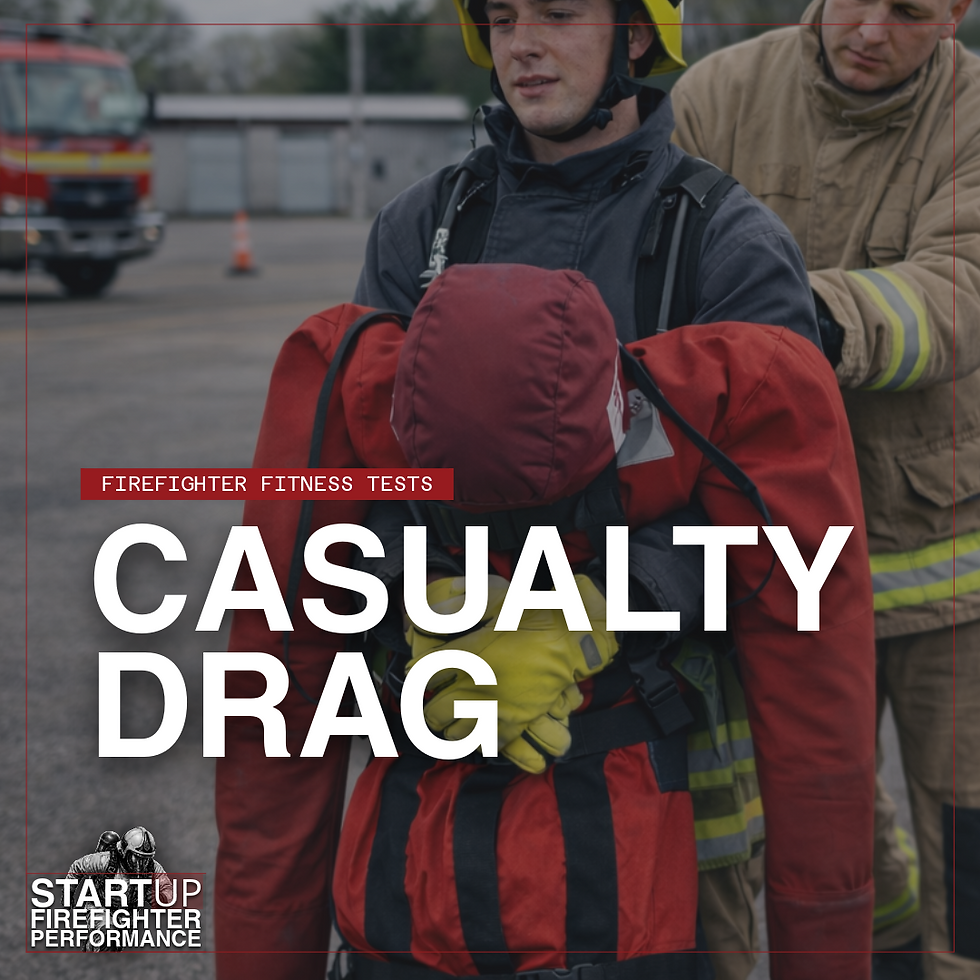
The Casualty Evacuation Test, also often called the Dummy Drag requires you to drag a rescue dummy weighing 55kg around a set up course. This course is usually 30m in length and shaped as a triangle or square.
The test is timed, and you must complete it within 30-45 seconds (depending on the service). It also differs each service as to whether the timer begins once you've picked up the casualty and standing by, or whether picking up the casualty is included in the overall time.
You complete the test by dragging the casualty by one of two carry handles (yes, I personally find this puzzling as real humans don't have carry handles), whilst walking backwards being directed by one of the instructors/assessors.
The trick for this test is to choose a carry handle that prevents you from kicking the dummy as you walk and not dropping/placing the dummy down for a rest. In fact, if you do this, you'll more likely fail as you'll lose so much time. Again, listen to the instructions carefully on your assessment day for what you can and can't do.
The Enclosed Space Test.

Crawl through some tunnels/confined space and make it out to the other side safely and in a considerate time whilst your vision is obscured and you're wearing breathing apparatus (not under air). That's what the Enclosed or Confined Space Test is.
It may differ between services whether your vision is obscured, whether there is an official time limit, or whether you wear breathing apparatus, but the overall methodology of the test applies - navigate the confined space and make it out.
To begin, you will be placed into some sort of rat run lets call it which is narrow and may include obstacles inside. With possibly obscured vision, you will be required to crawl through the system trying to make it to the end, problem solving obstacles (often turning/changing angles of your body), and potentially navigating levels (going up or down).
This test is all about remaining calm under pressure and keeping it cool to problem solve. Many people, particular bigger/taller people often fear they will not fit, but trust me, I've seen lots of tall or broader individuals fit through gaps I thought wasn't possible. It's all about remaining calm, adjusting your body, and taking a few seconds to think about your next actions.
It's important to listen to the instructions for this test too. If your course requires you to go down a level, it's often instructed that you must not enter the drop head first. If so, you've broken a safety critical rule and failed. Usually when this is the case, you end up at the drop head first, but there's no room to turn around in that section to go feet first. So what do you do? That's where the problem solving and spatial awareness comes to play.
The Equipment Assembly.

The Equipment Assembly is a practical test aimed at assessing your manual dexterity. I must admit, when I did this test, I couldn't help but wonder why this was even being assessed. But after seeing and hearing of people failing this test due to lack of practical skill, it does have a purpose.
If you want to be a firefighter, you need to be practical. You must be able to use your hands, and this assessment does filter this.
So what is the test?
Using pictures placed in front of you, you'll be required to follow instructions to assemble a peace of firefighting equipment (usually an old manual pump that is no longer in service, although it varies between services). Once the equipment has been put together correctly, you will usually have to then dismantle it for the test to be complete. There is normally a time limit which is fairly generous, so you don't need to rush it.
To make the test a little more tricky, you will be required to complete the full test whilst wearing firefighting gloves. Again, this is where taking your time can be your best advantage. Another thing to consider as well is the mistake of over tightening certain components during the test, making it 10x harder to dismantle and encouraging more pressure. There have also been many occasions where individuals have needed help dismantling due to this, consequently failing the test. So when you put the equipment together, make sure not to over tighten the components!
So to summarise, in fire gloves, assemble and dissemble a piece of equipment within a specified time, following the instructions provided. Don't over tighten and rush the assessment.
The Equipment Carry.
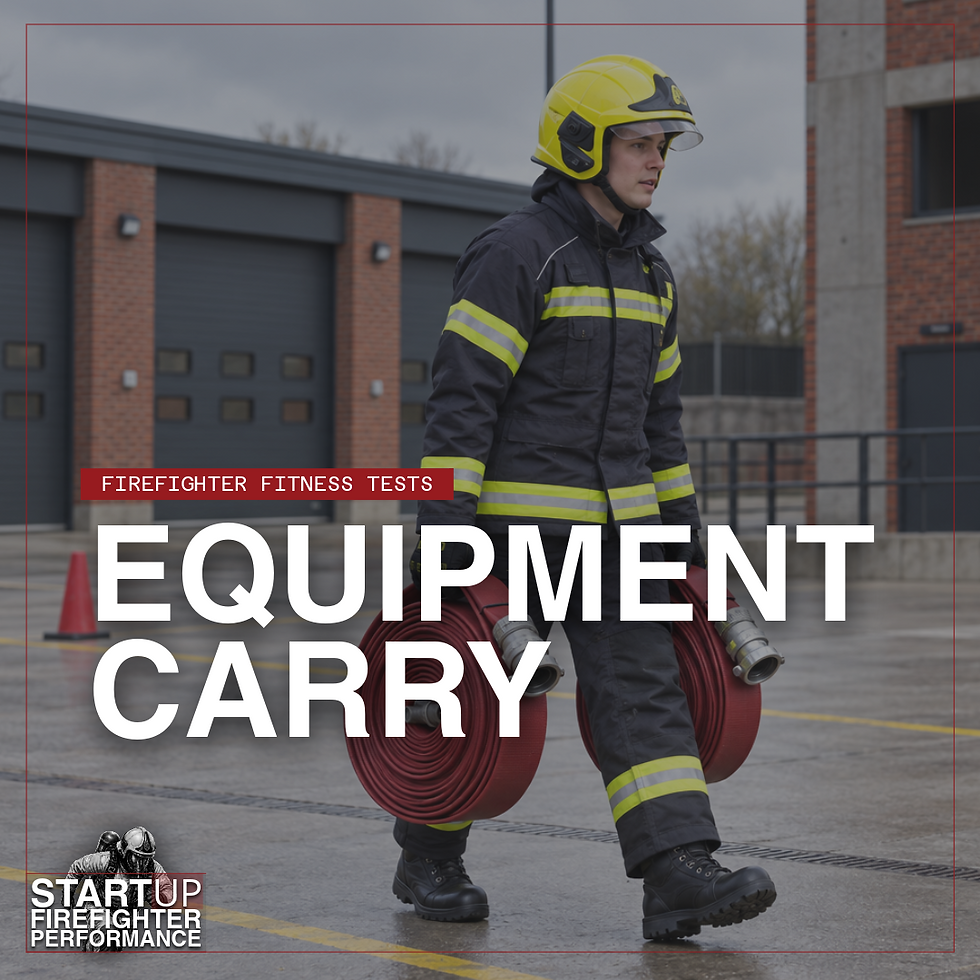
The Equipment carry is the most demanding test of the day. It requires full body strength and endurance, load carriage capability, aerobic and anaerobic fitness, grip strength, work capacity, core stability and lower body power.
This test in isolation is surprisingly relative easy, but what makes it more challenging is that you are required to complete it in full fire kit (excluding BA). This will be potentially the first day that you've donned firefighter PPE, therefore your body will not be used it so before you've even began the test, your heart rate has increased, you begin to increase in overall core temperature, and probably have some discomfort wearing the fire boots for the first time. In fact when I done mine, my boots were 2 sizes bigger than they should be due to lack of size 8's! To put this in perspective though, this test is commonly the final assessment of the day, so you've spent most of the day or time in that PPE. Without realising it, you've already began accumulating fatigue and expending energy, and that's without doing the other tests first!
For the test, you will be required to carry different types of firefighting equipment between two markers 25 metres apart for a number of shuttles. You must not drop any equipment and place them on the floor when switching.
Some services do slightly differ in execution, but the most common setup of the test is to complete the following tasks:
Run out a hose reel x 25m
Carry two coiled hoses x 100m
Carry one coiled hose x 25m
Carry a suction hose and basket/metal strainer x100m
30kg fixed barbell x 100m
Run x 225m total throughout the test (spread out throughout different equipment)
You have to complete the test within a given time, which is usually around the 5:47 mark. It can place considerable demand on aerobic fitness, muscular endurance, grip strength and the ability to continue moving efficiently while fatigued.
ADDITIONAL ASSESSMENTS
More than just the six above.
As mentioned before, the 6 assessments discussed above are not all of the tests used - only the most common with enclosed space/confined space test and ladder climb being the most frequently used assessments across whole-time and on-call processes (62 uses for the enclosed space test and 61 uses for the ladder climb). I've purposely structured this guide to focus on those 6 and will do another on additional assessments, however here is a list of other assessments which may appear in recruitment processes across the sector:
Ladder Extension
Ladder Extension to Lower
Ladder Pull/Lateral Pull Down
Shoulder Press
Hose Running Assessment
Swimming Assessment
Self Rescue Water Test
Fireground Fitness Test
Drill Ground Assessment
V02 MAX TESTING
Firefighter aerobic fitness tests
Depending on the service you apply to, you may have additional aerobic fitness tests. Some services conduct these on your physical assessment days, and some wait until your medical. A few even do both.
When the fire service assess your aerobic fitness, they should be assessing whether you meet the minimum standard, which is a V02 Max of 42.3 ml/kg/min. This standard is derived from research measuring the metabolic demands of essential firefighting tasks, including hose running, casualty evacuation, stair climbing and equipment carrying (Siddall et al, 2016).
The most common assessments used include the 20m Multi Stage Fitness Test (MSFT), otherwise known as the Bleep/Beep Test, the Chester Treadmill Test and the Chester Step Test. Some services also utilise bespoke local assessments that they've included themselves, like the 1.5 mile best effort run.
I will be doing individual guides for each assessment, so I won't go into detail here. The key takeaway however is that when preparing for your physicals, you must be aiming to improve your aerobic fitness - both anaerobic and aerobic. This is not something that improves overnight, so give yourself plenty of time and prepare well in advance. Check out our assessment guides to learn more about how to prepare for each test (coming soon).
An overall conclusion.
The physical assessment stage is often towards the end of the recruitment process or attached to an interview stage/day. Although the exact combination of tests varies between Fire and Rescue Services, the ladder climb, ladder lift, casualty evacuation, enclosed space test, equipment assembly and equipment carry are among the most commonly used assessments across the UK.
Passing these tests requires more than general fitness. You must demonstrate sufficient aerobic fitness, strength, muscular endurance, grip strength, coordination and mobility, alongside practical qualities such as confidence, manual dexterity, problem solving and the ability to remain calm under pressure. Just as importantly, you must listen carefully and follow every instruction given by the assessors, as breaking a safety critical rule will result in failure regardless of your physical ability, and this is such a cheap way to fail.
Before beginning your preparation, check the current recruitment information provided by the Fire and Rescue Service to which you are applying. Identify the exact tests, standards and time limits you will face, then give yourself enough time to prepare for those specific demands. If you're not sure how, then click here.
The assessments are achievable, but they should not be underestimated. Prepare early, train consistently and practise moving efficiently while carrying load and working under fatigue. Arriving physically prepared, understanding what each test involves and remaining composed throughout the assessment day will give you the best possible chance of success.
FIREFIGHTER PREPARATION
Applying to become a firefighter or preparing for firefighter recruitment?
Understanding the physical tests is only the first step. Your preparation needs to develop the fitness, strength and physical capability required to perform across all assessments and training school.
The Firefighter Fitness Preparation Course (FFPC) provides individualised training for aspiring UK firefighters, built around your current fitness, the Fire & Rescue Service you are applying to and the physical demands you need to prepare for.
From aerobic fitness and strength development to firefighter-specific physical preparation, your programme is structured to help you arrive at your assessments stronger, fitter and better prepared.
Check out the details here:
References for this guide:
All services have been referenced in this guide, but to keep the reference list concise, not all services have been included below.
Cheshire Fire and Rescue Service (2026) ‘National Firefighter Selection Tests’. Available at: https://www.cheshirefire.gov.uk/jobs/wholetime-firefighter/-national-firefighter-selection-tests/
Hereford and Worcester Fire and Rescue Service (n.d.) ‘National Firefighter Fitness and Selection Tests’. Available at: https://www.hwfire.org.uk/careers/on-call-firefighter/national-firefighter-physical-tests/
London Fire Brigade (n.d.) ‘Fitness tests’. Available at: https://www.london-fire.gov.uk/careers/become-a-firefighter/fitness-tests/
Ramsbottom, R., Brewer, J. and Williams, C. (1988) ‘A progressive shuttle run test to estimate maximal oxygen uptake’, British Journal of Sports Medicine, 22(4), pp. 141–144. doi: https://doi.org/10.1136/bjsm.22.4.141.
Scottish Fire and Rescue Service (2025) ‘Practical selection tests (PSTs)’. Available at: https://www.firescotland.gov.uk/careers/practical-selection-tests-psts/
Siddall, A.G., Stevenson, R.D.M., Turner, P.F.J., Stokes, K.A. and Bilzon, J.L.J. (2016) ‘Development of role-related minimum cardiorespiratory fitness standards for firefighters and commanders’, Ergonomics, 59(10), pp. 1335–1343. doi: https://doi.org/10.1080/00140139.2015.1135997.
Sykes, K. and Roberts, A. (2004) ‘The Chester Step Test—a simple yet effective tool for the prediction of aerobic capacity’, Physiotherapy, 90(4), pp. 183–188. doi: https://doi.org/10.1016/j.physio.2004.03.008.
Comments